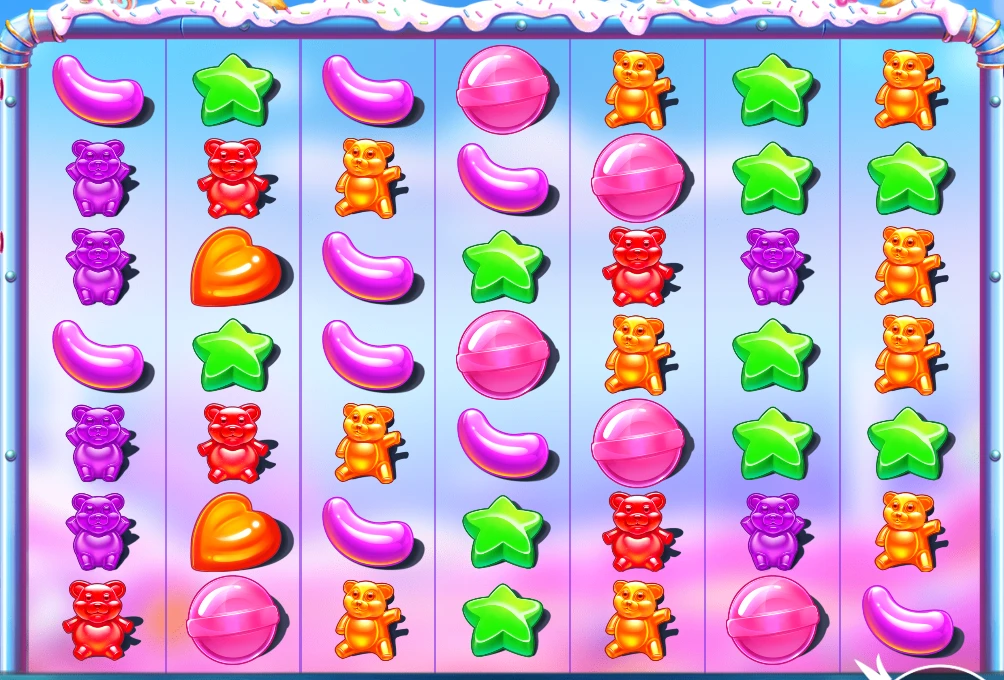
Which Sugar Rush does this guide cover?
Pragmatic Play launched the original Sugar Rush on 30 June 2022. Instead of fixed paylines, it uses connected groups of sweets on a grid. One bet can lead to several payouts as winning symbols disappear and replacements fall into the gaps.
Recognising the original 2022 game
Look for the title Sugar Rush without an added subtitle. Sugar Rush 1000, Sugar Rush Xmas and Sugar Rush Super Scatter are separate releases. Similar artwork does not mean their rules or numerical limits can be transferred to the original. For the 2024 sequel, with multipliers up to ×1,024 and a 25,000× maximum win, see our Sugar Rush 1000 guide.
The original game identifier is vs20sugarrush. When opening a player from a catalogue, check the title before reading its paytable against this guide. This avoids mistaking a newer variation for the game described here.
Why the grid matters after a win
A sweet may disappear, but the position it occupied can remain important. Winning positions are marked and can develop multipliers on later hits. To follow a round, watch both the new symbols and the marks underneath them rather than the falling sweets alone.
Understanding the Sugar Rush 7×7 grid
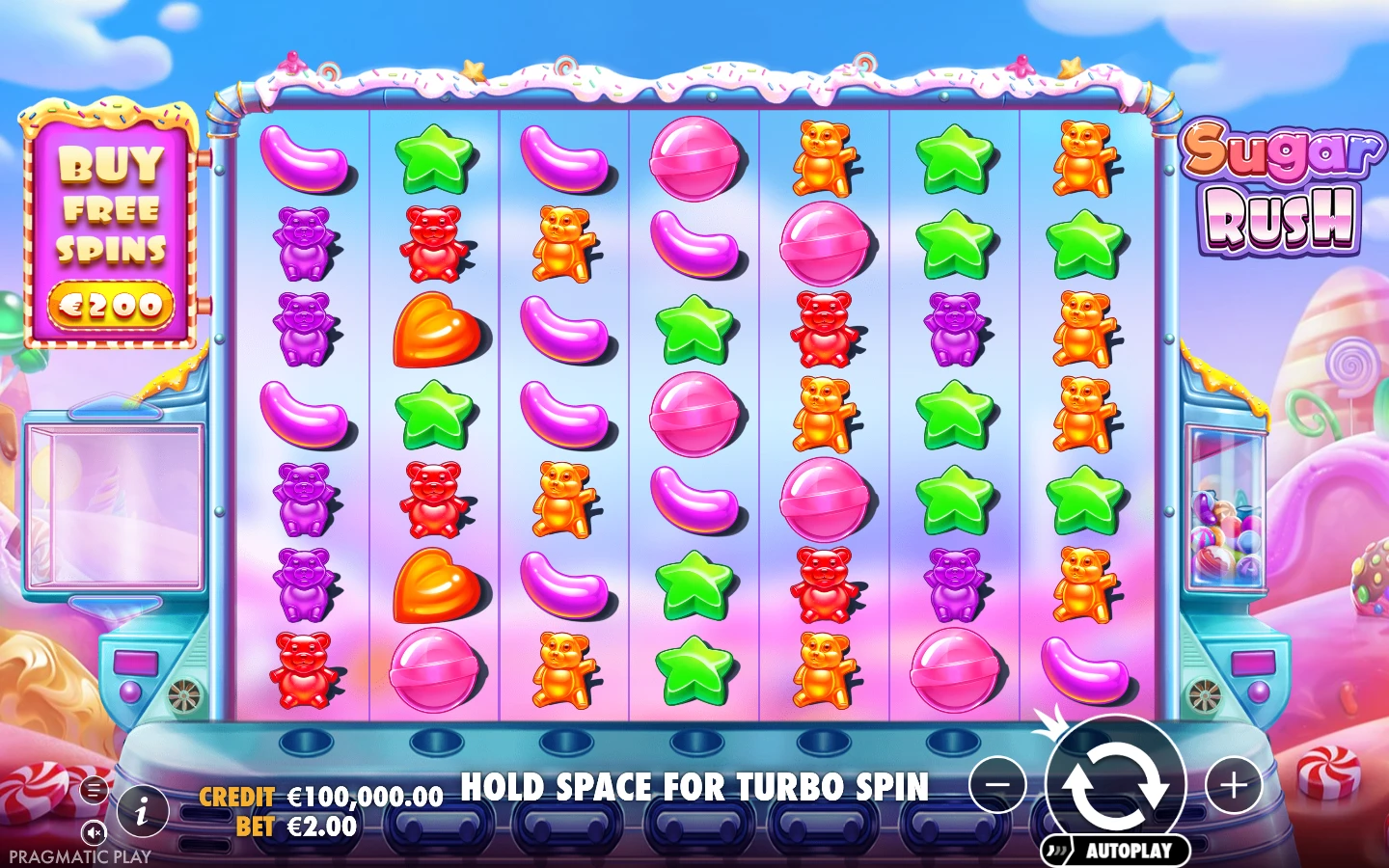
Seven rows and seven columns give Sugar Rush 49 positions. There is no payline to trace from the left edge of the screen. A paying group can form anywhere on the grid, provided enough matching symbols connect through their sides.
Horizontal and vertical connections
Symbols connect to the matching neighbours immediately above, below, left or right. A diagonal touch alone does not join two groups. When checking an irregular shape, follow each connection through matching symbols rather than jumping across a different sweet or an empty-looking gap.
Reading a symbol and its position separately
Each position holds a symbol, while marks and multiplier values belong to the position itself. A different sweet can land there after a tumble. Do not follow a multiplier down the screen as though it were attached to the sweet that just moved.
What makes a winning cluster in Sugar Rush?
A cluster needs at least five matching symbols connected horizontally or vertically. Five sweets of the same kind scattered around the screen are not enough if they remain separate. The game evaluates the connected group, not the total number of that symbol anywhere on the grid.
Counting a group rather than a straight line
A paying cluster can bend or branch; it does not have to make a rectangle or a single row. Count all matching symbols connected to the group by their sides. Looking only at its longest row can miss part of a valid cluster.
Cluster size and the paytable
The official description covers groups of 5–15 or more matching symbols. Their payouts depend on both the symbol and the size bracket in the paytable. Reaching the five-symbol threshold does not mean every type of sweet pays the same amount.
The published payout of up to 150× refers to a cluster. It is not the overall maximum win for the game, and it is not the ceiling of a position multiplier. Keep these different measures separate when comparing figures.
How tumbling wins extend a single spin
When a cluster pays, its winning symbols disappear and new symbols fall into place. The refreshed grid can produce another paying cluster. Several animations and payouts can therefore belong to the same paid spin, rather than each tumble taking a separate bet.
Following the tumble sequence
Watch the highlighted winning group first, then the cleared spaces and the replacement symbols. The grid is evaluated again after the drop. This is why a spin’s running win total can increase even though you have not pressed the spin button again.
Knowing when the round has finished
The chain ends when no further paying cluster forms. Wait until the full sequence has resolved before reading the result. A marked position does not keep the chain going by itself: a new qualifying group still needs to appear on the grid.
Paying sweets and scatter symbols
Sugar Rush uses sweets such as gummy bears and jellybeans as its theme. Ordinary symbols have their own entries in the paytable, linking their appearance to payout values. Scatter symbols serve a different purpose: they trigger the free-spins feature through a separate count.
Checking the paying symbols
Open the paytable to match each symbol drawing with its payout and required group size. Colour alone can be difficult to distinguish on a small screen. Check the shape as well, especially when several similar-looking sweets sit close together after a tumble.
Keeping scatters separate from clusters
The five-symbol minimum applies to paying clusters, not to the bonus trigger. Free spins start from three scatters. Do not try to treat scatter symbols as an ordinary sweet that must form a five-symbol connected group before it can activate the feature.
| Symbol | 5 symbols (× bet) | 15+ symbols (× bet) |
|---|---|---|
| Pink sweet | 1× | 150× |
| Orange heart | 0.75× | 100× |
| Purple jellybean | 0.5× | 60× |
| Green star | 0.4× | 40× |
| Red bear | 0.3× | 30× |
| Purple bear | 0.25× | 25× |
| Orange bear | 0.2× | 20× |
How position multipliers reach up to 128×
Multipliers develop on positions that take part in wins. They are not a permanent boost applied to every symbol on the screen. Even a high value displayed on a position needs a relevant winning cluster; the number alone does not produce a payout.
A winning mark comes before a multiplier
A first winning hit marks the position. When that position wins again in the sequence, its multiplier starts at 2×. This makes the initial mark different from an active numbered multiplier: a newly marked square has not immediately reached the top value.
The doubling progression
Further winning hits on a position double its multiplier up to 128×. The progression is 2×, 4×, 8×, 16×, 32×, 64× and 128×. Positions develop separately, so one area can carry a larger value while another is only newly marked.
When several multiplier positions are part of the same winning cluster, their values are added together for that cluster. They are not multiplied by one another. Check every involved position rather than reading only the single highest number visible on the grid.
How long marks last in the base game
In the base game, follow marks within the current spin’s tumble sequence. They are not a balance of multipliers saved from one ordinary paid spin to the next. Keeping positions through a whole series of spins is the distinctive rule of the free-spins feature.
An addition example, not a recorded win
Fictional example: a cluster covers positions showing 2× and 4×. The calculation is 2× + 4× = 6×, so its base payout is multiplied by six.
Do not calculate 2× × 4× = 8×. This example explains the rule; it was not a winning sequence observed in the demo.
Triggering the Sugar Rush free-spins feature
Scatter symbols award an initial series of free spins. Three scatters reach the first tier, with larger awards through the seven-scatter tier. The table shows the number of spins granted at the trigger, not a forecast of what the feature will pay.
Reading the free-spins award
The free-spins counter measures the length of the awarded series, not the number of winning rounds. A free spin can finish without a paying cluster. A larger initial award gives more spins, but it does not set a minimum profit or a fixed bonus return.
The feature can be extended: landing 3, 4, 5, 6 or 7 scatters during free spins awards another 10, 12, 15, 20 or 30 spins respectively. Scatters can appear anywhere on the screen; they do not need to form an adjacent cluster to count.
Marks persist throughout the feature
Marked positions and their multipliers stay in place for the entire free-spins feature. A later spin can therefore use a position developed earlier in the bonus. This is the main difference to watch when moving from a base-game tumble sequence into free spins.
Persistence describes the state of the grid, not a promise to pay. If new symbols do not form the required winning groups on those positions, a large displayed multiplier cannot create a win on its own.
| Scatters | Free spins awarded |
|---|---|
| 3 | 10 |
| 4 | 12 |
| 5 | 15 |
| 6 | 20 |
| 7 | 30 |
The feature purchase costs 100× the bet
The launch announcement describes an option to buy access to the feature for 100 times the bet. That puts a substantial cost into a single action. Check whether the option is actually present in the player: its description does not guarantee availability in every location.
Checking the full purchase cost
The price is a multiple of the selected bet, not a fixed amount that stays the same after a stake change. Read the displayed total and any confirmation carefully. A smaller-looking base bet can still translate into a much larger feature-purchase cost.
Immediate access does not mean a profitable bonus
Buying the feature removes the wait for a scatter trigger; it does not buy a favourable result. Compare the bonus payout with the whole purchase cost. An animated win total can still leave a net loss when that total is smaller than the amount paid to enter.
Bets, gross payouts and your Sugar Rush budget
Your bet is the amount committed to a round. Its payout is the amount returned when the round resolves. Keeping these figures separate matters because a winning animation does not necessarily mean your balance is higher than it was before the spin or session.
Reading the net result
For an ordinary round, subtract the bet from the total payout to understand the net result. With a purchased bonus, account for the purchase price instead. Comparing the starting and ending balances is more useful than treating every number labelled as a win as profit.
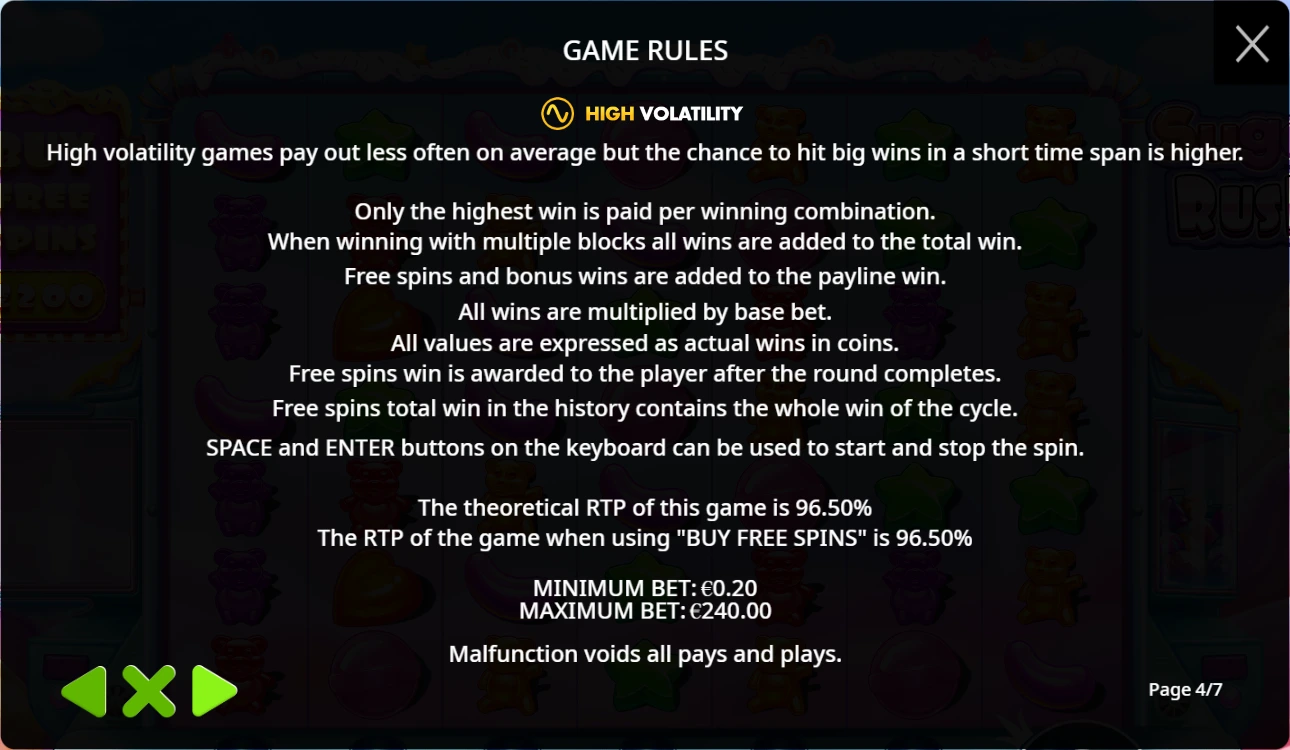
The inspected euro demo rules list a normal bet range of €0.20 to €240. This describes that demonstration version, not the limits at every operator or a range in your local currency. Check the amount actually selected in the player before starting a spin.
Setting a pace and a spending limit
Decide the limit before the first spin and include any feature purchases in that budget. A lower stake reduces the amount committed per action, but does not turn the game into a winning strategy. Taking breaks makes it easier to track spending across several rounds.
What Sugar Rush’s 96.50% RTP means
Pragmatic Play publishes an RTP of 96.50% for Sugar Rush. Return to player is a theoretical measure over a very large volume of bets. It is not the percentage of your starting balance that you should expect to have left after a short demo or cash session.
A theoretical average is not a refund
RTP does not mean each bet returns a fixed share, or that a losing spin must be compensated by the next one. Individual results can differ greatly from the average. Watching a short run of demo spins does not provide a reliable measurement of the published rate.
Separating 150×, 128× and the overall maximum
The published 150× concerns a cluster payout; 128× is the limit for a position multiplier. Separately, the demo rules set the overall maximum win at 5,000× the bet, in both the base game and free spins. These figures measure different parts of the game.
If the free-spins total reaches the 5,000× cap, the feature ends immediately and any remaining free spins are forfeited. This is a limit in the rules, not an expected result or a payout won during our inspection.
High volatility, same RTP for the feature purchase
The rules label Sugar Rush as high volatility, so payouts can be very uneven rather than forming a steady return. That label does not predict the next win. The demo lists 96.50% RTP for both normal play and the free-spins purchase.
A practical way to explore the Sugar Rush demo
Use the demo to recognise symbols, tumbles and changing grid positions without staking money. Its balance consists of play-money credits. The external player loads after your launch action, so you can read the explanations first instead of starting a round immediately.
Starting in the provider’s player
Choose the launch button and wait for the Sugar Rush title and interface. Check that you are in a demo before taking an action. If a screen asks for a deposit or a gambling-account login, do not continue on the assumption that everything remains play-money activity.
Reading the information menu before spinning
Find the paytable, stake controls and rules first. Then allow each round to play slowly enough to distinguish the winning group, its removal and the following tumble. The aim is to understand how the game displays its mechanics, not to collect a supposedly representative set of results.
What a demo cannot establish
Play-money credits cannot be withdrawn, and a bonus in the demo says nothing about when a cash bonus will arrive. The demo also does not verify an operator’s withdrawal terms, account service or your local eligibility. Those are separate questions from how the game works.
Using Sugar Rush on a mobile screen
On a phone, the grid takes up much of the screen and controls may be compact. Find the spin button, selected stake and information menu before starting. A different orientation may make the game easier to read, but it does not change its rules.
Orientation and touch controls
Choose the orientation that keeps both symbols and amounts legible. Full-screen availability depends on the browser and player; stay in the embedded view if it is not offered. Avoid repeated taps while an animation is running, as these may result in an unintended action.
Loading, sound and returning to the guide
Let the player finish loading before trying again. If it stays blank, close the demo and relaunch it from the page. Mobile audio may require an initial interaction. Closing or reloading can interrupt a play-money session, so do not rely on keeping its balance or grid state.
Avoid chasing losses on Sugar Rush
Cascades and position multipliers make changes on the grid easy to notice, but they are not a system for winning. A high number can draw attention away from the amount being spent. Your stopping point should remain the limit set before play, not an anticipated bonus.
No staking system can guarantee the next win
A run of losses does not oblige the next paid spin to win. Marks retained during a bonus are a rule of that feature, not evidence that a new base-game bet is due to pay. Raising the stake to recover losses can increase spending without guaranteeing recovery.
Legal age, breaks and limits
This information is for adults aged at least 18, or the higher local legal age. Do not gamble with money needed for everyday expenses. If sticking to a limit becomes difficult, end the session and use appropriate spending controls, blocking tools, time-outs or self-exclusion.